From the engineering desk
In-House vs. Outsourced Hardware Engineering: A Decision Framework
Building a hardware team runs $640K–$960K a year and takes 6–12 months to stand up. When to hire, when to outsource, and why most enterprises land on hybrid.
By Axon Labs Engineering
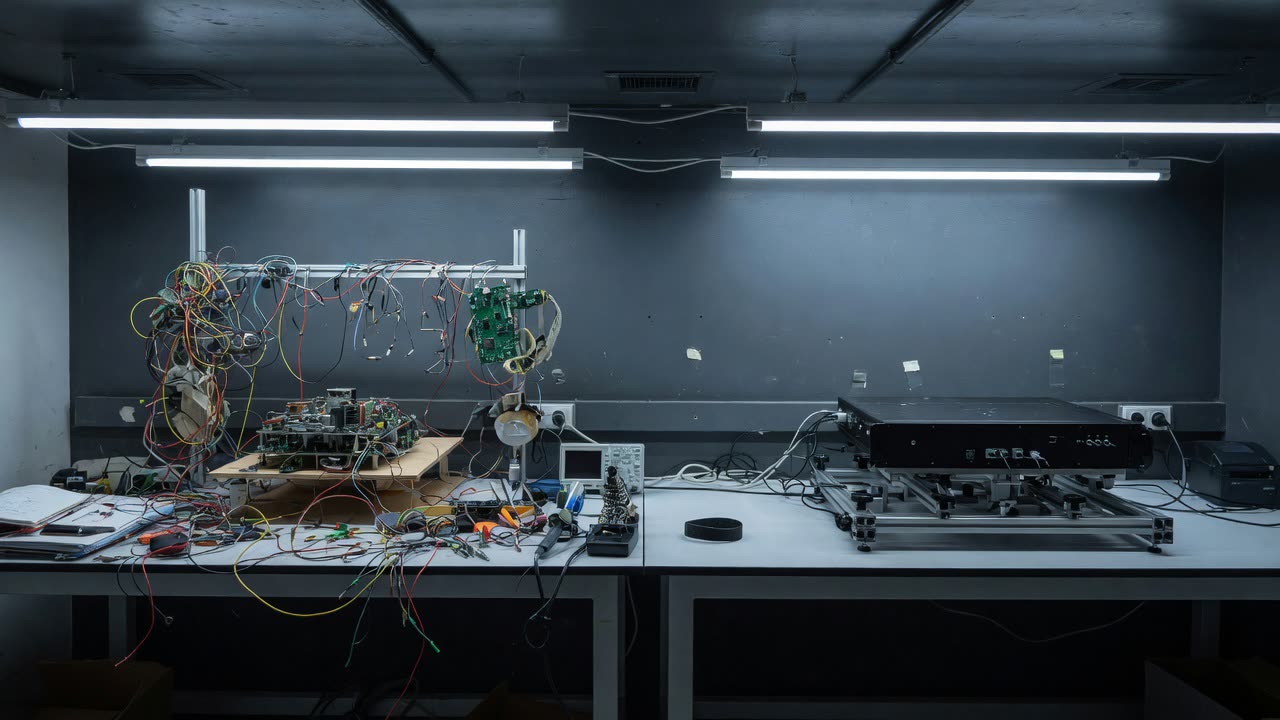
You have a validated product concept and no internal path to build it. The instinctive move — start hiring — commits you to $640,000–$960,000 a year and a 6–12 month wait before the team is productive. The instinctive alternative — outsource everything — trades that for a coordination problem most first-time hardware companies underestimate. Neither instinct is the answer. This is the framework we walk enterprise clients through when the real question is not “which is cheaper” but “which is right for this product, at this stage.”
Key takeaways
- A 2026 in-house hardware team (2–3 engineers plus a manager, with tooling, recruiting and overhead) costs $640K–$960K annually and takes 6–12 months to reach productivity; an outsourced team runs $96K–$240K and is productive in 2–6 weeks (industry cost analyses, 2026).
- Cost isn’t the deciding factor — fit and stage are. In-house wins where the engineering is your durable competitive moat; a firm wins on immediate multi-discipline access and shipped-product pattern recognition.
- Most enterprises land on hybrid: product strategy, architecture and security stay in-house; execution, scaling and specialized work go outside — with a planned handoff.
What does each model actually cost in 2026?
How fast can each model start?
When does in-house win?
- The engineering is the product. If your core IP is a control algorithm, a sensing method, or a manufacturing process you’ll refine for years, that knowledge should compound inside the company.
- You iterate continuously. Daily, tight product-engineering loops — where the team shipping v1 is already shaping v2 — reward co-located institutional memory.
- You’ll ship many products. A steady pipeline amortizes the year of hiring; a single product doesn’t.
- Retention compounds. The engineer who chose the silicon handles the cost-down two years later without re-learning the system.
When does a development firm win?
- You need all disciplines now. A firm brings electronics, firmware, RF, mechanical and manufacturing engineering to the table on day one, scaled up or down per phase.
- You’ve never shipped this before. A team that has cleared EVT, DVT and PVT gates dozens of times knows where first-time programs die — and prices in fewer surprises.
- The work is bursty. Development is intense then quiet; a firm’s capacity flexes where a payroll can’t.
- Transfer is planned. The best firm engagements end with a manufacturing package and documentation a factory — or your future in-house team — can take anywhere.
Why most enterprises land on hybrid
| Function | Best kept in-house | Best outsourced |
|---|---|---|
| Product strategy & requirements | Yes — it’s your market knowledge | |
| System architecture & security | Own the decisions | Augment with specialists |
| Multi-discipline execution (EVT–PVT) | Yes — breadth and speed | |
| Specialized engineering (RF, edge AI) | Yes — rare, expensive to hire | |
| Manufacturing transfer | Own the relationship | Firm produces the package |
| Long-term iteration & cost-downs | Yes — knowledge compounds |
The five questions that settle it
- Is the engineering your moat, or your path to one? Moat → in-house. Path → firm or hybrid.
- How many products will this team ship in three years? One or two → don’t build a department for it.
- Can you wait 6–12 months to start? If the market window is tighter than your hiring timeline, the decision is made.
- Do you have the disciplines to even hire well? Hiring an RF engineer without an RF engineer to interview them is how first teams mis-hire.
- What happens to the team between products? Idle senior engineers are expensive; plan for the trough, not just the peak.
Per hour, a firm looks expensive. Per shipped product, iterations decide the bill.
The bottom line
- In-house runs $640K–$960K a year and 6–12 months to productivity; outsourced runs $96K–$240K and 2–6 weeks — but total cost to a shipped product is set by iteration count, not rate.
- Choose in-house when the engineering is a durable moat and you’ll ship many products; choose a firm for breadth, speed and first-product pattern recognition.
- Hybrid — strategy and architecture in, execution out, planned handoff — is the enterprise default, and it only works if the partner’s deliverables actually transfer.
Frequently asked questions
Is it cheaper to build a hardware product in-house or outsource it?
How long does it take to build an in-house hardware team?
When should I keep hardware engineering in-house?
What is a hybrid hardware development model?
What hidden costs does outsourcing hardware engineering carry?
Sources
- SSN Technologies — IT Outsourcing vs In-House Development: True Cost Comparison (2026) · verified 23 July 2026
- HR Future — Hiring Embedded Engineers: The Real 2026 Cost · verified 23 July 2026
- Trio — In-House Development vs Outsourcing in 2026 · verified 23 July 2026
- Innowise — In-house vs Outsourcing Software Development 2026 · verified 23 July 2026
- Starshot Software — Outsourcing vs In-House Development: Real Cost Comparison · verified 23 July 2026
- VA Masters — Outsourcing vs In-House Hiring 2026: Cost Data & Framework · verified 23 July 2026
- PurePower — Outsourcing Engineering Services vs In-House Engineering Teams · verified 23 July 2026
If the product has to ship, talk to the team that builds for that outcome.
Senior engineer on the first call. NDA before technical detail. References available under NDA after qualification. Or start with a fixed-fee feasibility study.