From the engineering desk
Can Your Product Run a Language Model? SLMs on Embedded Hardware
Small language models fit in 1–2 GB and run without the cloud. What it actually takes — in RAM, bandwidth, power and BOM — to ship one in a device.
By Axon Labs Engineering
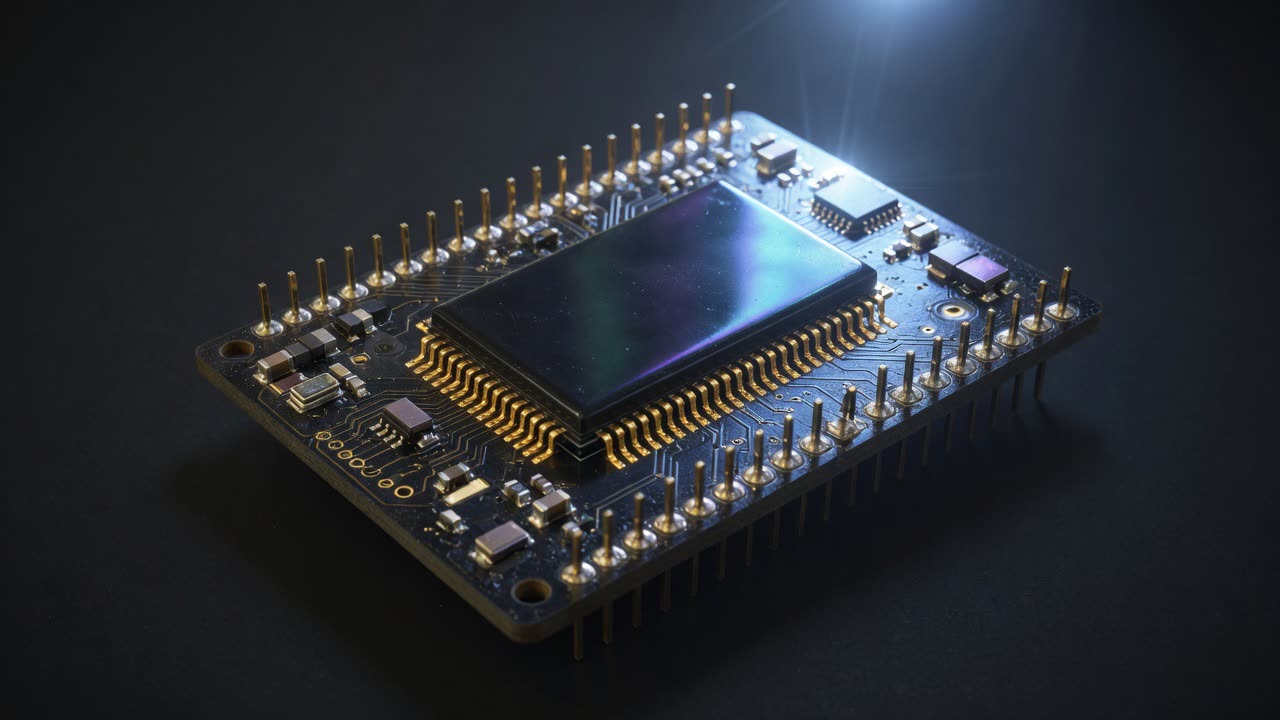
In 2026, small language models crossed from demo to deployable: Microsoft’s Phi-4-Mini quantized to 4-bit fits in roughly 1.2 GB, down from 7.6 GB in FP16, and runs interactively on phone-class silicon. The coverage stops at phones and laptops, though. The harder question — the one we get in feasibility studies — is whether a product can run one: a device with a BOM ceiling, a battery, and no fan. The answer is yes, more often than you’d think, but the gate isn’t the one the datasheets advertise.
Key takeaways
- 2026-generation small language models (0.5–14B parameters) run real product features on device: Phi-4-Mini at 4-bit fits in ~1.2 GB, Gemma 4 E2B in ~1.5 GB.
- Decode is memory-bound, not compute-bound: mobile-class silicon moves 50–90 GB/s against 2–3 TB/s in the data center, so tokens-per-second follows bandwidth — TOPS is the wrong spec to shop by.
- Ship the cascade — always-on wake word, on-device SLM for commands and dialogue, cloud for the long tail — and validate latency, memory and accuracy on the target silicon as a phase gate.
What is a small language model — and why did 2026 change the answer?
The real gate is memory, not TOPS
What fits where: silicon classes for language
| Silicon class | Realistic language capability | What it enables |
|---|---|---|
| MCU-class accelerator (<1 W) | Keyword spotting, intent grammars — tens of millions of parameters, not billions | Wake words, fixed command sets. Not language generation. |
| NPU module / mid-range SoC (1–10 W, 2–4 GB RAM) | 0.5–4B models at 4-bit | Spoken commands, structured dialogue, on-device Q&A over product docs |
| High-end edge SoC (10–30 W, 8 GB+) | 4–14B models at 4-bit | Assistant-grade conversation, summarization, multimodal pipelines |
What does a language interface cost the BOM?
- RAM is the new BOM line. The delta from 1 GB to 4 GB of LPDDR4X is dollars — real, but small against the cloud-inference subscription it replaces over a device lifetime.
- Power is per-interaction, not always-on. Decode is a burst workload; duty-cycle it behind a wake word and the battery story survives. Sustained conversation is where thermals bite — a fanless enclosure at multi-watt decode needs the thermal design done early.
- The cloud line never fully disappears. Keep it for the long tail, and price the on-device tier as what it is: latency, privacy and COGS insurance.
Local, hybrid, or cloud: the placement test
A talking product is a regulated product
The model and compression playbook
- Pick for the task, not the leaderboard. A 1B model fine-tuned on your product’s domain beats a general 7B model that doesn’t fit your RAM. The 2026 bench — Phi-4, Gemma, Qwen3, Llama 3.2 — all ship small variants with permissive licensing tiers (BentoML, 2026); check the license against your commercial use before falling in love.
- Quantize to 4-bit as the default. It’s the difference between fitting and not fitting; recover quality with quantization-aware fine-tuning on your domain data — the same prune-quantize-distill stack from our edge AI guide applies.
- Budget the context window like power. KV cache grows linearly with context; an unbounded chat history is a memory leak with a UX. Decide the context your feature actually needs and cap it.
- Choose a runtime you can ship. llama.cpp for portability, ExecuTorch and vendor SDKs where NPU support is real for your chip. Verify claimed acceleration on your board — mid-2026, much of it isn’t wired up yet.
- Validate on target, as a phase gate. Tokens/second, memory high-water mark, thermal steady-state and task accuracy on the actual board, with pass/fail thresholds at EVT — the same evidence discipline as every other subsystem in hardware product development.
Budget the memory bandwidth, not the TOPS.
The bottom line
- Yes, your product can probably run a language model in 2026 — a quantized 0.5–4B SLM on a 4 GB-RAM SoC is the practical floor, and it removes cloud latency, connectivity dependence and per-query COGS.
- Shop by bytes and bandwidth, not TOPS: decode speed ≈ memory bandwidth ÷ model size, and mainstream runtimes still bypass most NPUs for language.
- Ship the cascade — wake word, local SLM, cloud long tail — disclose the AI at first interaction, and put model updates inside the signed-OTA architecture the CRA already requires.
Frequently asked questions
Can a microcontroller run an LLM?
How much RAM does an on-device language model need?
How fast is on-device language inference in 2026?
Which small language models fit embedded products in 2026?
Do NPU TOPS make language models faster?
Sources
- CogitX — Small Language Models (SLMs): Comprehensive Guide 2026 · verified 19 July 2026
- martinuke0 — The Rise of Local LLMs: Optimizing Small Language Models for Consumer Hardware in 2026 · verified 19 July 2026
- arXiv — LLM Inference at the Edge: Mobile, NPU, and GPU (2603.23640) · verified 19 July 2026
- MayhemCode — Best CPU for LLMs in 2026: What Actually Matters for Local AI Performance · verified 19 July 2026
- BentoML — The Best Open-Source Small Language Models (SLMs) in 2026 · verified 19 July 2026
- Chandra (Meta) — On-Device LLMs: State of the Union, 2026 · verified 19 July 2026
- Finbarr Timbers — How is LLaMa.cpp possible? · verified 19 July 2026
- SiliconFlow — The Best Small LLMs For Edge Devices In 2026 · verified 19 July 2026
- Digital Applied — Small Language Models for On-Device Agents in 2026 · verified 19 July 2026
- AI Act Explorer — Article 50: Transparency Obligations (Regulation (EU) 2024/1689) · verified 19 July 2026
If the product has to ship, talk to the team that builds for that outcome.
Senior engineer on the first call. NDA before technical detail. References available under NDA after qualification. Or start with a fixed-fee feasibility study.