From the engineering desk
Wearable Health Device Development: Feasibility to Certification
Classification, BOM, antennas, batteries and false positives — the engineering decisions that decide whether a health wearable ships.
By Axon Labs Engineering
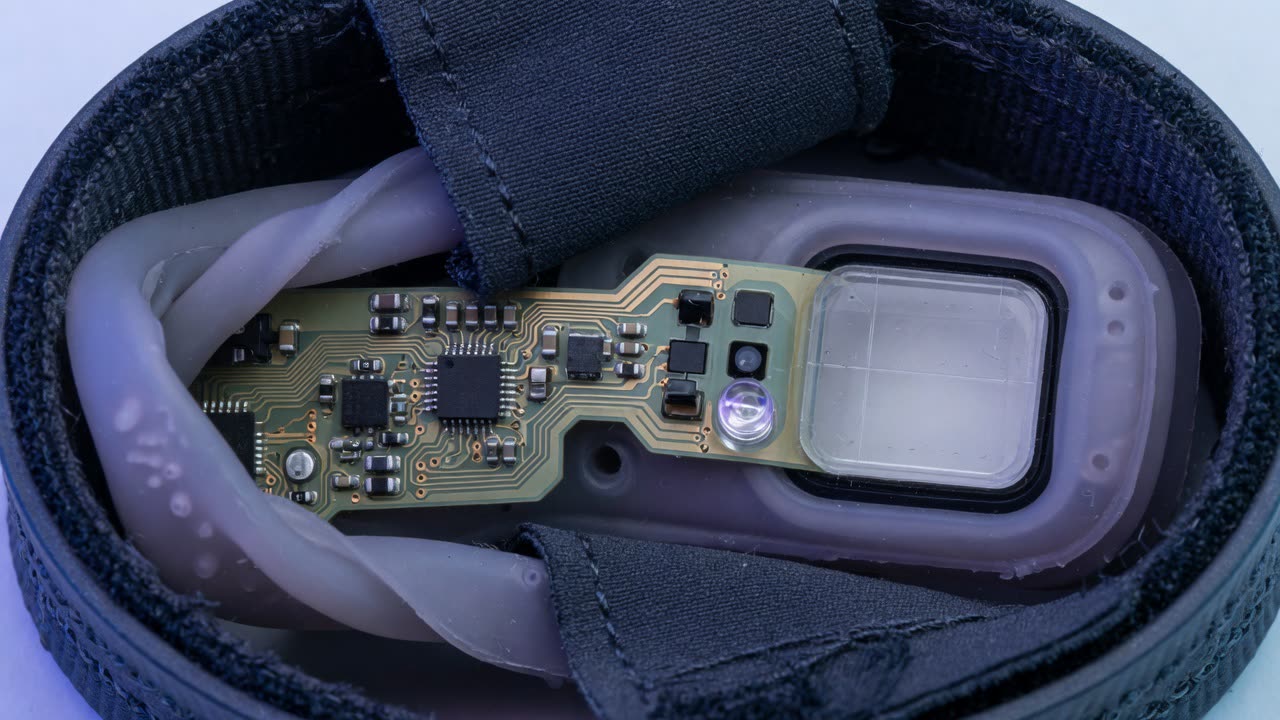
A health wearable is the hardest class of connected product: it lives on a body, runs on a battery, senses continuously, and answers to regulators. In 2026 the wearable medical device market crosses $68 billion on its way to a projected $330 billion by 2033 — and most of the products chasing that market will fail on the same five constraints. We’ve shipped through all five. This is what the path actually looks like.
Key takeaways
- The wearable medical device market grows from $68.1B in 2026 to a projected $330.5B by 2033, a 29.5% CAGR (Grand View Research) — home healthcare is already the largest application at 51.8% of revenue.
- The classification decision — wellness product vs. medical device — shapes architecture, evidence, timeline and budget more than any technical choice. Make it first, deliberately.
- Field performance, not lab accuracy, is the product: fall-detection systems hit 97.9% sensitivity in validation, but false positives in real homes are what determine whether users keep the device on.
What does it take to develop a wearable health device?
Medical device or wellness product?
| Wellness product | Medical device | |
|---|---|---|
| Claims | General health, fitness, awareness | Diagnose, treat, prevent, alert |
| Evidence | Internal validation | Clinical data, documented verification |
| Quality system | Good engineering practice | ISO 13485 QMS, design controls, IEC 62304 software |
| Timeline impact | Baseline | Add months to years, by class |
| Can you upgrade later? | Yes — if the architecture anticipated it | Downgrading claims is easier than retrofitting rigor |
The five constraints every health wearable fights
- Form factor. The enclosure is set by the body, not the electronics. Everything else negotiates for the space that remains.
- BOM ceiling. Health wearables sell against a price expectation. The ceiling is a day-one architecture input — see why BOM cost is designed in, not negotiated out.
- Intelligence placement. Which decisions happen on-device and which in the cloud — the hybrid architecture question — drives silicon, power, and connectivity all at once.
- Always-on sensing. Continuous monitoring on a battery means duty-cycled cascades, not brute force.
- Certification readiness. Wireless compliance, skin-contact biocompatibility (ISO 10993), and the claims decision above — planned at architecture, not discovered at DVT.
Engineering a wearable to a sub-$50 BOM
- Right-size the silicon to the duty cycle. A modest MCU running a compressed model beats a premium SoC idling at 1% utilization. On the insole, hybrid AI — light inference on-device, analytics in the cloud — is what kept the compute bill small.
- Fuse sensors instead of adding them. Pressure plus IMU, fused in software, replaced additional sensing hardware. The model is NRE; a sensor is a per-unit cost, forever.
- Co-design antenna, enclosure, and board. Separately optimized parts don’t compose in a wearable envelope. Co-design avoided the respin spiral that quietly doubles BOMs.
- Make DFM a day-one constraint. Part count, standard fasteners, mold-friendly geometry — decided before the first prototype, per the prototype-to-manufacturing playbook.
Antenna design in impossible form factors
- Body-load from day one. Simulate and measure against tissue phantoms early — free-space antenna performance is fiction for wearables.
- Buy the antenna its keep-out first. Reserve the volume and ground-plane clearance before the battery and sensors negotiate; retrofitting clearance means moving everything.
- Co-design, don’t integrate. Antenna, enclosure material, and board stack-up are one electromagnetic system. CMF choices — metallization, coatings — are RF decisions wearing design clothes.
- Budget certification headroom. Intentional-radiator testing runs $9,000–$15,000 per attempt (Compliance Testing, 2026); a detuned antenna found at the test lab is a board spin plus a re-queue.
Always-on sensing on a wearable battery
- Budget by duty cycle, not peak draw. The spreadsheet that matters multiplies each stage’s power by its fraction of the day. Build it before choosing silicon — MCU-class accelerators now run trigger models at under a watt (Promwad, 2026), and far less duty-cycled.
- Count memory and radio, not just compute. Transmitting a raw sensor stream costs more than inferring on it locally and sending events — on-device AI is a battery strategy as much as a latency one.
- Design charging behavior, not just capacity. A health device charging nightly monitors nothing overnight. Charge cadence is a clinical-coverage decision disguised as an electrical one.
BLE, LTE-M, or Wi-Fi: how should a health wearable connect?
| BLE (phone-tethered) | LTE-M / NB-IoT (standalone) | Wi-Fi (fixed-location) | |
|---|---|---|---|
| Power | Lowest | Moderate, manageable with eDRX/PSM | High for battery wearables |
| Coverage | Wherever the phone is | Carrier network, roams with the user | One building |
| BOM & recurring cost | Cheapest, no subscription | Modem + antenna + carrier plan | Low BOM, no plan |
| Fails when… | Phone absent, unpaired, dead | Coverage gaps, plan lapses | User leaves home |
| Fits | Fitness, phone-native users | Safety alerts, senior care, clinical monitoring | Bedside and home-fixture devices |
Fall detection AI and the false-positive problem
- Engineer specificity, not just sensitivity. The false-alarm budget — alarms per user-month — is a top-level spec with a number, not an aspiration.
- Fuse modalities the impostors can’t fake. An IMU alone confuses sitting hard with falling. Pressure plus inertial data — gait context before the event — separates them. This is the sensor-fusion-over-redundancy play from our edge AI guide, applied clinically.
- Escalate, don’t alarm. On-device inference flags a candidate; cloud analytics weigh it against the user’s baseline; unanswered check-ins escalate. Hybrid architecture is a false-positive filter.
- Validate on field data at the gates. Lab datasets are the hypothesis. Free-living data from instrumented pilots — worn wrong, half-charged, on real gaits — is the evidence that passes EVT.
Certification-ready from day one
A wearable that isn’t worn detects nothing. Comfort is a clinical feature.
The bottom line
- Make the classification decision first and deliberately — then engineer one tier stricter than you claim. It’s the cheapest optionality in the program.
- The five constraints — form factor, BOM, intelligence placement, always-on power, certification — must be solved simultaneously. Feasibility exists to find the one that breaks.
- Field performance is the product: false-alarm budgets, body-loaded antennas, and free-living validation data decide adoption, not lab metrics.
- Standalone safety products need standalone connectivity. If the promise dies when the phone is absent, so does the product.
Frequently asked questions
How much does it cost to develop a wearable health device?
Is my wearable a medical device?
How accurate is wearable fall detection?
What connectivity should a health wearable use?
How do wearables achieve multi-day battery life with continuous sensing?
Sources
- Grand View Research — Wearable Medical Device Market Size Report, 2026–2033 · verified 13 July 2026
- Fortune Business Insights — Wearable Medical Devices Market Size | Forecast Report · verified 13 July 2026
- Market.us — Wearable Medical Devices Statistics and Facts (2026) · verified 13 July 2026
- CDC — Facts About Falls — Older Adult Fall Prevention · verified 13 July 2026
- CDC — Older Adult Falls Data · verified 13 July 2026
- NCOA — Get the Facts on Falls Prevention · verified 13 July 2026
- Sensors (MDPI) — Wearable Fall Detection System with Real-Time Localization and Notification Capabilities · verified 13 July 2026
- PMC — Real World Accuracy and Use of a Wearable Fall Detection Device by Older Adults · verified 13 July 2026
- PMC — A Decade of Progress in Wearable Sensors for Fall Detection (2015–2024) · verified 13 July 2026
- FDA — General Wellness: Policy for Low Risk Devices (Guidance) · verified 13 July 2026
- Promwad — Embedded AI Hardware Platforms 2026 · verified 13 July 2026
- Compliance Testing — How Much Does FCC Testing Cost? · verified 13 July 2026
- I'm Alive — Elderly Fall Statistics — Updated Data for 2026 · verified 13 July 2026
If the product has to ship, talk to the team that builds for that outcome.
Senior engineer on the first call. NDA before technical detail. References available under NDA after qualification. Or start with a fixed-fee feasibility study.